BREAKING — Yale’s Sonnenfeld & Tian: Cloudflare’s Appeal Won’t Fix What’s Broken in Delaware’s Chancery Court
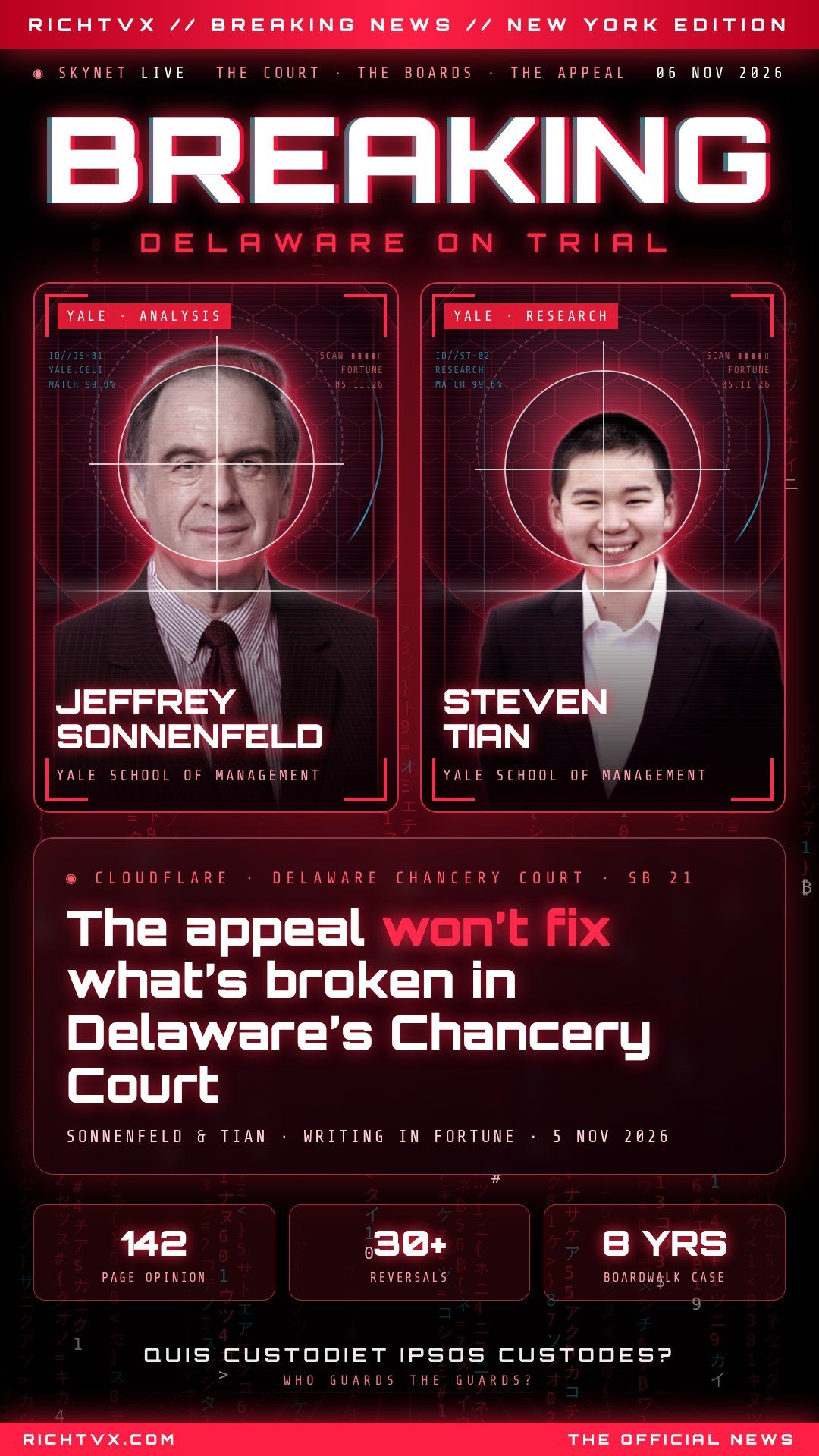
- One day after their first Fortune column on the Cloudflare ruling, Vice Chancellor J. Travis Laster sent his own decision up to the Delaware Supreme Court.
- Writing in Fortune on 5 November 2026, Yale’s Jeffrey Sonnenfeld and Steven Tian say boards should not read that as the system fixing itself.
- Delaware’s 2025 corporate law reform, Senate Bill 21, was written to protect deals that a committee of independent directors approves.
Bottom line
One day after their first Fortune column on the Cloudflare ruling, Vice Chancellor J. Travis Laster sent his own decision up to the Delaware Supreme Court. Writing in Fortune on 5 November 2026, Yale’s Jeffrey Sonnenfeld and Steven Tian say boards should not read that as the system fixing itself.
What the court did
Delaware’s 2025 corporate law reform, Senate Bill 21, was written to protect deals that a committee of independent directors approves. In a 142-page opinion, the judge accepted that the law applied, found Cloudflare’s directors independent and not negligent, and even praised the visible care of their process. He still blocked the plan, by giving “good faith” a new and wider meaning.
The authors point to the evidence he leaned on: board members using the Signal messenger, a chief executive known for his temper, the lack of a fairness opinion that, as the opinion itself admits, no Delaware rule requires, and a “controlled mindset” idea borrowed from a 2011 case. The judge also wrote that, without the defendants’ “credibility problems”, he could have applied the safe harbor — after a one-hour hearing on paper, without meeting the witnesses.
Why the authors say it is wrong
For twenty years Delaware’s highest court has tied bad faith to intent: knowingly ignoring one’s duties (Disney, 2006), good faith as part of the duty of loyalty (Stone v. Ritter, 2006), and only a knowing, complete failure counting as disloyal (Lyondell, 2009). A process that could have been better is a question of care — and the court found no failure of care.
They also dispute how the opinion describes their own role: the special committee asked them to present years of published research on when dual-class shares work and when they fail, not to back a result.
Reversed, but sent back
The Delaware Supreme Court has overturned this judge more than 30 times, the authors write, yet keeps sending cases back to him. The Boardwalk Pipeline dispute has moved between the two courts for eight years; in the 2019 Aruba case the high court openly rebuked him. Lawyers’ fees in such cases can run from $60 million to more than half a billion dollars.
What boards should take from it
Until the Supreme Court says clearly what good faith demands of an independent, diligent board — and until reversals carry consequences — directors should assume that a sound process may not protect them in Chancery. The authors close with Juvenal: “Quis custodiet ipsos custodes?” — who guards the guards?
Disclosure by the authors: Cloudflare’s special committee retained them to present their published research on dual-class shares; they gave no view on the terms of Cloudflare’s plan, take no position on its design and have no relationship with the judge.
Read the full commentary by Jeffrey Sonnenfeld and Steven Tian on Fortune ↗




 WOAH!
 Crediio
 U.S. Intelligence News
 WireKnox
 Confessio
 YOOO! Digital
 RichXAds
 Guarded by CERBERUS