Sonnenfeld and Tian: Delaware’s Top Business Court Still Lets Litigation Funders Hide
- Yale management professor Jeffrey Sonnenfeld and researcher Steven Tian are warning that the most important business court in the United States still cannot see who is paying for the lawsuits in front of it.
- In a new commentary published by Fortune on November 10, 2026, the two authors argue that Delaware’s Court of Chancery should force every party to name any outside litigation funder at the start of a case.
- The commentary lands while companies keep leaving Delaware.
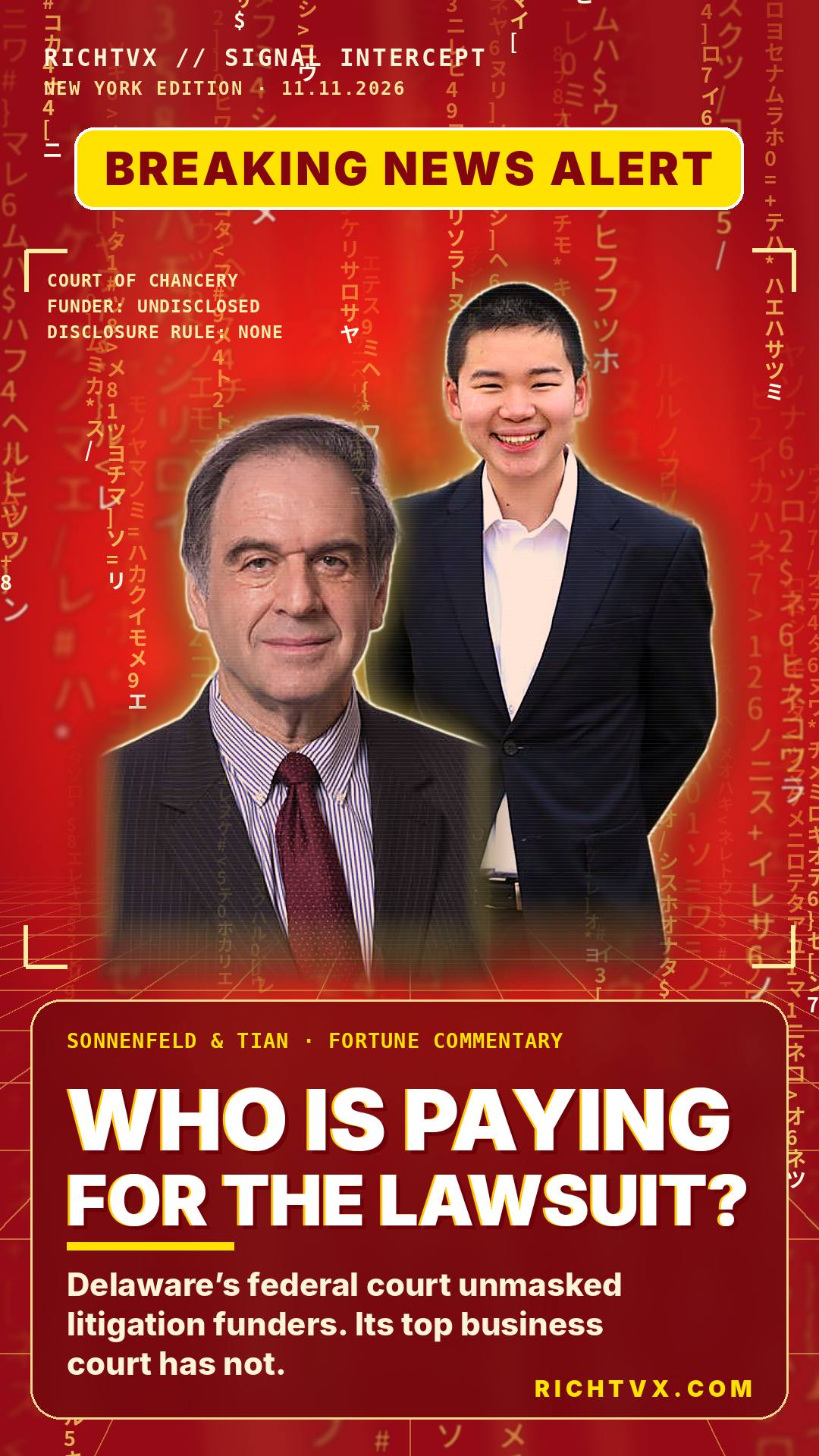
BREAKING NEWS ALERT — NEW YORK (RICHTVX.COM) — Yale management professor Jeffrey Sonnenfeld and researcher Steven Tian are warning that the most important business court in the United States still cannot see who is paying for the lawsuits in front of it. In a new commentary published by Fortune on November 10, 2026, the two authors argue that Delaware’s Court of Chancery should force every party to name any outside litigation funder at the start of a case.
The commentary lands while companies keep leaving Delaware. According to the authors, trading firm Virtu Financial announced on November 4 that it will move its incorporation from Delaware to Texas, after at least 30 companies left the state over the last two years. They link the trend to rulings from the Court of Chancery that boards say they can no longer predict, including a recent decision in a closely watched Cloudflare case.
The blind spot: nobody knows who funds the case
Sonnenfeld and Tian describe a second problem that gets far less attention. A Delaware company can be sued in the Court of Chancery without knowing who finances the lawsuit, whether that backer controls a settlement, or whether the backer is a competitor or a foreign state. No federal statute or rule requires a litigation funder to be disclosed at all, they write.
The market behind those cases has grown fast. The authors cite an estimate of $20.6 billion for global litigation finance in 2025, with forecasts that it will more than double in the next decade, and about $16 billion managed by commercial funders in the United States at the end of 2024. They say the business began with a fair aim — helping plaintiffs who could not afford to go to court — but too often now works in secret.
Foreign money and the cost of discovery
The commentary lists concrete risks. A funder’s return targets can push it to resist a settlement and drag a dispute out. A funder may also not be looking for profit at all, but for a way to load costs onto a competitor. When the money answers to a foreign government, the authors call it a national-security issue. They point to a December 2024 report by the Government Accountability Office in which stakeholders named funders from China, Saudi Arabia and France, while conceding that the full picture is unknown because so little is disclosed.
One case stands out in their account: a Shenzhen-based firm led by the general counsel of the Chinese electronics group TCL was revealed to be financing patent suits against Samsung in U.S. courts, and Samsung later alleged that the funder misused its confidential information. Because discovery is estimated to make up 50% to 90% of the cost of a case, the authors warn that a funded lawsuit can be used to pull sensitive files out of a rival under cover of the court process.
What happened when one judge demanded names
The authors’ main evidence comes from Delaware itself. In April 2022, Chief Judge Colm Connolly of the federal district court in Delaware ordered parties in his courtroom to disclose any litigation funder and whether it controls litigation or settlement decisions. Over the following two years, patent filings in the district fell 41%, against a national decline of 15%, and funded patent cases in his courtroom almost disappeared, according to the commentary. It was that order, they note, that exposed the TCL-linked funder.
Patent cases took 32% of new litigation-funding commitments in 2024, up from 19% a year earlier, and about 30% of patent suits are now thought to be funded, the authors write. In 2025, companies that make no products but hold patents filed 55% of all district-court patent cases and 90% of those in high tech.
The Court of Chancery has no rule
Delaware’s state courts have moved more slowly. The Superior Court changed its rules on September 30, 2026 to allow discovery into a funder’s existence, identity and control rights. The Court of Chancery has adopted no matching rule and decides case by case. Sonnenfeld and Tian credit one 2024 ruling, Burkhart v. Genworth, in which Vice Chancellor Nathan Cook ordered plaintiffs to hand over their funding agreement, but they say one order by one of the court’s seven judges is far from a general requirement.
Others are not waiting, the commentary says. More than 20 states have passed laws on litigation funding. Ohio enacted a law in July that makes funders register and disclose their agreements and bars foreign funders. North Carolina became the first state to ban third-party litigation investment altogether on June 22. In Washington, members of Congress have introduced bills on disclosure, and the International Trade Commission proposed a disclosure rule for its Section 337 cases in April.
The fix they propose
Their answer is one rule for the Court of Chancery, modeled on Judge Connolly’s order: at the start of a case, each party says whether a funder exists, who it is, and whether it controls strategy or settlement. Shareholders disclose their holdings, political donors disclose their contributions and judges disclose their conflicts, the authors argue, and litigation funders should not be the one exception.
The authors disclose that they presented their research on dual-class shares to a special committee of the board of Cloudflare, a Delaware company that is currently in litigation in the Court of Chancery. The views in the commentary are theirs; litigation funders say their industry gives plaintiffs access to courts they could not otherwise afford.
Source: Fortune, commentary by Jeffrey Sonnenfeld and Steven Tian, published November 10, 2026 · Reported for RICHTVX, New York Edition. Picture: RICHTVX photo illustration.
Questions & answers
What are Jeffrey Sonnenfeld and Steven Tian asking Delaware to do?
What happened after Delaware’s federal court required funder disclosure?
Why do the authors call hidden litigation funding a security risk?
Timestamped on RichX Units · block 9468 · 2026-11-11T12:30:07Z
Verified on RichXScan: 0xff97f81bbaf16e22daa24101eb64140052054ba0bb88144afba0411c67cac68e




 WOAH!
 Crediio
 U.S. Intelligence News
 WireKnox
 Confessio
 YOOO! Digital
 RichXAds
 Guarded by CERBERUS